
EARLY ACCESS: Chapters 1-3
You’re seeing this because it matters who reads it first.
The people who read this first are the ones who decide if it spreads.
Appreciate you being early.
Jump ahead to Chapter 2 and Chapter 3.
Chapter One
Making the Identity Shift from Manager to Coach
The growth and development of people is the highest calling of leadership.
—Harvey S. Firestone
In June 2015 I had a coaching call with a sales leader, who I will call Stan, that I will never forget. It was the day that I realized why sales leaders don’t get in the field to coach their teams. Prior to this call, I would have blamed lack of knowledge or perhaps lame meetings as the main culprit. But that day I realized sales leaders could have clear calendars and all the training on how to coach, but without this one thing, they won’t coach. What was it?
The belief that coaching is their primary job.
On the call, I asked Stan, “How is the team doing with the new content we covered in our live session last month?”
Stan hemmed and hawed by saying, “Oh, they’re doing pretty good.” I knew right in that moment that Stan had not coached one single person.
Rather than chastise Stan, I decided to ask him a few clarifying questions. I said, “Stan, how many one-on-one coaching sessions did you do in the last three weeks?”
He replied, “Well, I’ve had a couple of conversations with team members, and we had a really great sales rally!”
I paused and then said, “You didn’t do any coaching sessions, did you?”
Stan’s voice got quiet, and he replied, “Well . . . no, not really.” I could tell he was embarrassed, and I didn’t want him to feel like I was catching him doing something wrong. I asked him to share why he didn’t really get to any of the coaching sessions. His reply blew me away. He said, “Well, I’d love to coach people, but that’s not really my primary role.” When I asked him to share what he believed his primary role was, Stan said, “To manage processes, open new communities, hire and fire, and set up pricing.”
You see, Stan’s issue wasn’t an issue of capability or desire. His issue was that he believed his job was about the direction of managing processes more so than developing people. From that point on, our coaching calls were focused on changing his belief about what his job role was.
That’s the point of this chapter . . . to shift your belief, or your identity, to that of a coach.
Leader as Coach
I want you to think about who your best team member is. I don’t mean the one who makes the most sales alone. I’m talking about the one who hits sales quotas, is a problem-solver, is low maintenance, and is enjoyable to work with.
Now think about your worst team member. If you could duplicate one of them, which one would you duplicate? If you’re not a weirdo, you likely said you’d duplicate your easy, productive team member, right? It would be great to be able to hire a bunch of people who had all the right qualities and skills, but that’s just not reality. So, it’s fair to say that you are going to have to develop those skills and habits to have a team that operates on all cylinders.
In the following chapters, I am going to give you the tools and skills to develop your team, but you need to know, right here and now, that this is your primary job. As a leader, you are a coach first and foremost.
When you focus on developing your team’s skills, there are some inherent benefits:
Fewer problems to have to handle
More fun on the job
A self-managing team
Fewer late-night phone calls
But here are the two major benefits of developing your team:
More sales
More revenue
Key Skills + Mastery = Additional Revenue Death by Meeting
Death by Meeting
I am a huge fan of Patrick Lencioni. In particular, his book Death by Meeting had a profound impact on me.
I recall in 2004, I was sitting in an all-day manager meeting (#punchmeintheface). I remember thinking, “Why the heck does this meeting take all freaking day long?” I knew that I could have been more productive out in the field. Instead, we were in an all-day meeting “talking” about how to make more sales instead of coaching our sales team to make more sales!
The meeting was led by our new VP of sales, Stacy. Stacy was from the South and had the twang in her voice to prove it. Lucky for me, Stacy was looking for ways to shake up the routine from the prior sales VP. This all-day meeting was a part of the old leader’s legacy. At the lunch break,
I pulled Stacy aside and told her I was going out to the field to go get some more sales. She looked at me like I had lost my mind. She said, “But we aren’t done with our meeting.”
I looked right at her, knowing I could lose my job, and said, “I know. Call me if you need me.” With that, I walked out of the building and headed to the field to get more revenue rather than talk about how to get more revenue.
That was the day I became a RevenueGetter. Frankly, it’s why my company, Impact Eighty- Eight, has the tag line “A Performance Improvement Company.” I truly believe that to get more revenue in the door, you must improve your team’s performance.
The Core Mindset of a RevenueGetter
The ultimate goal of this book isn’t just to give you strategies, tools, or scripts; it’s to help you take on a new professional identity.
In my sales seminars, I often say that management is not the direction of people, it’s the development of people.
That’s not just a clever line. It’s the foundation of everything you’ll read in this book.
The promise of RevenueGetter is simple: if you make this shift, you will learn to coach your team in a way that builds skills, drives sales, and creates lasting performance improvement. But that only happens if you decide . . . right here, right now . . . to embrace these nonnegotiable mindsets:
My job is to coach my team consistently, not when I have time, not when numbers dip, but as a daily discipline.
I will measure performance improvement relentlessly because what gets measured gets improved, and guessing is not a strategy.
I will inspire my team intentionally . . . knowing that my words, actions, and example set the emotional climate for the entire sales floor.
I will protect our culture fiercely, guarding against complacency, negativity, and anything else that erodes performance or morale.
These aren’t “nice to haves.” They are the DNA of a true RevenueGetter. If you adopt them, your team will feel it. Your results will reflect it. And your career will never be the same.
The Revenue Formula
Prior to Impact Eighty-Eight, I worked with Shore Consulting, led by Jeff Shore. In 2023, Jeff released a YouTube video where he taught what he calls the Revenue Formula.¹ Here is that formula:
Revenue = Price x Traffic x Conversion
I won’t reteach it here—you can find it easily online if you want to watch it in its entirety—but what I will say is that if you have a certain revenue goal and you aren’t hitting it, you have three options:
Increase your prices.
Increase your traffic.
Increase your conversion rate.
Perhaps you could do all three of these. My observation over the last twenty-five years is that you can only raise prices so much before you create a pricing barrier. As far as traffic goes, you could increase traffic to a certain extent, but there is likely a cap on that as well. But if I ask you if your sales team is maximizing every sales opportunity, odds are high that you would say, “We could be doing better.”
By focusing on increasing your conversion rates, you will increase your revenue by the greatest amount without more ad spend or discounting your product to win the sale.
Conversion Case Study
Let’s say you sell high-end luxury watches through an online and in-store retail model. Here are your current numbers:
Price per watch: $10,000
Monthly traffic: 1,000 qualified shoppers
Conversion rate: 2 percent (20 sales per month)
Revenue: $10,000 x 20 sales = $200,000/month
Now let’s see what happens when you adjust each lever:
1. Increase Traffic by 20%
New Traffic = 1,200 shoppers Conversion Rate = still 2% = 24 sales Revenue: $10,000 x 24 = $240,000
Result: $40K gain
2. Increase Price by 5%
New Price = $10,500
Traffic = 1,000 shoppers
Conversion Rate = still 2% = 20 sales Revenue: $10,500 x 20 = $210,000
Result: $10K gain
3. Increase Conversion Rate by 2 Points (from 2% to 4%)
Traffic = 1,000 shoppers Conversion Rate = 4% = 40 sales Revenue: $10,000 x 40 = $400,000
Result: $200K gain
Summary
+20% more traffic = +$40K
+5% price increase = +$10K
+2% conversion rate increase = +$200K
Once again, improving conversion rate drives the largest revenue gain, without more marketing spend or risking customer resistance to higher prices.
Why does this matter so much? Well, if you have been in leadership for any length of time, you’re probably familiar with the following typical conversation with a salesperson:
Steve the Sales Leader: “So John, we are down on sales and need to make something happen pretty quick. What do you need to make it happen?”
John: “Well, I feel that if I had a little more back-pocket money or a better incentive, that might get us a couple of deals. I know the Hinkley family would likely convert.”
Steve: “Okay. Let me see if I can make that happen. Anything else?”
John: “Yeah . . . the traffic has really sucked recently. It’s also been kinda slow. If you could tell marketing to change things up and get me more qualified traffic, that would totally help. These people I am talking to are a waste of time.”
Steve: “Roger that. I’ll see what I can do.”
Steve runs off to save the day by decreasing revenue with a larger incentive for John and convinces marketing to increase their efforts to make more sales. But Steve never stopped and looked at John’s conversion efforts. No skill development or coaching at any level. Steve is not a RevenueGetter. Steve is a RevenueLoser.
The point of this book is for you to look at increasing your team’s conversion efforts first! Believe me when I tell you there are sales that are left on the table because you aren’t converting at the highest levels possible. And if you are converting at the highest levels possible, I am curious as to why you are reading this book. Maybe your VP or company president is making you read it. In that case, sorry, not sorry.
¹Jeff Shore Real Estate Sales Training, “The Revenue Formula: Price x Traffic x Conversion – 5-Minute Sales Training,” YouTube, August 19, 2023, https://www.youtube.com/watch?v=UzpkscjbSIU.
The Payoff
Reread the quote at the beginning of this chapter by Harvey S. Firestone. The payoff is fulfillment and legacy. Yes, getting more revenue is the immediate payoff, but it’s way more than that.
I cannot tell you how many people I have coached who are now division presidents, company owners, top salespeople, and more. Watching someone reach their full potential is what it’s all about.
Let me share a great example of this. In the spring of 2002, I was running a new-hire class for a Fortune 100 home builder. In that class was a young man by the name of Brian Raab. Brian was a bartender at a swanky club in the Biltmore area of Phoenix.
Brian had a dream of opening up a series of restaurants in the Phoenix area and was looking at selling homes as a way to create a little capital to get that dream started. I had many coaching sessions with Brian, and sure enough, he became a top producer at our company.
I am not one of those coaches who claims responsibility for someone’s success, but I know that I likely had an influence on Brian. Brian left our company in 2006 to chase his dream. Today, Brian owns and operates multiple award-winning restaurants in the Phoenix area, including The Mission and The Fat Ox. He also just launched his own tequila brand.
I am so proud of that dude. The fact that I might have influenced his success is worth more than any monetary reward I could imagine.
It’s true—growth and development of others is the highest calling.
How do you accomplish that? You become a coach and a RevenueGetter!
Summary
At the heart of this chapter is a simple but powerful truth: Sales leaders don’t avoid coaching because they’re too busy or lack training; they avoid it because they don’t believe it’s their primary role. Stan’s story made that point impossible to ignore. Until you shift your identity to “leader as coach,” all the tools, techniques, and free time in the world won’t get you into the field developing your people. The leaders who consistently drive revenue, prevent problems, and build high-performing teams are the ones who treat coaching not as an occasional activity but as the central focus of their role.
When you commit to coaching as your primary responsibility, your priorities become sharper and your impact grows. You stop relying on short-term fixes like discounts or more traffic and instead focus on improving the one factor with the biggest payoff . . . conversion! Over time, you’ll see your people achieve more than they thought possible, often surpassing even their own expectations. The reward is more than sales and revenue; it’s the legacy of having developed others into leaders, top performers, and success stories. That starts with a belief shift: You are not just a manager of processes; you are a coach and a RevenueGetter.
Questions to Ponder
• What percentage of your time each week is spent managing processes versus developing people? (Be honest. This is about self-awareness, not perfection.)
• If your team’s conversion rate improved by 10 percent, what impact would that have on your revenue and your leadership reputation?
• What limiting beliefs about your role as a leader might be holding you back from embracing the identity of a coach? (For example: “I’m too busy,” “Coaching is HR’s job,” “It’s faster to fix problems myself.”)
Before we dive into the skills and tools in the next chapters, take a moment to assess your current leadership identity. Are you operating as a manager or a coach? Go to RevenueGetter.com/tools to find out how you rank.
Chapter Two
The Six Manager Styles
Leadership is not about being in charge. It’s about taking care of those in your charge.
—Simon Senek
As we established in the introduction, most sales leaders don’t receive any training on how to effectively coach their teams. That being the case, managers tend to default into five alternative leadership styles. I know the chapter title says six. We will get to the sixth one, but first, let’s get into the five incorrect styles.
With each and every style, I am going to share with you the challenges that each will have in becoming a RevenueGetter through coaching.
Style #1: The Buddy
This manager holds the belief that if the salesperson likes me, they will perform for me. The manager will try to hang out with the salesperson outside of work and have a personal relationship beyond the office.
I am not saying personal relationships are necessarily bad, but it isn’t a strategic performance improvement style. It’s more of a hope style. In other words, I hope you like me well enough to hit your goals. As the late, great business philosopher Jim Rohn used to say, hope is not a strategy.
The downside of this leadership style is that it makes it super awkward for everyone when the salesperson isn’t performing. The sales leader will avoid confrontational talks and coaching sessions. Forget challenging the salesperson beyond their own beliefs and capabilities. To the Buddy, this would seem pushy.
Here’s a typical conversation between a salesperson and the Buddy:
Stephanie (the Buddy): “Hey, Angie. I could really use your help. Margie is all over me to get some more sales from you. You think you could help a sister out?”
Angie: “Well, I mean, sure. But let her know I am doing everything I can out here. What else do you want me to do?”
Stephanie: “I know you are . . . and I told her. Don’t shoot the messenger. Just do what you can. I would really appreciate it.”
Angie: “Okay. Will do.”
Stephanie: “Oh . . . I forgot to tell you I found a new spot for happy hour. You want to go
tonight?”
Angie: “Totally.”
Style #2: The Server
These managers are always bringing coffee and lunch to their salespeople. They hold the belief that if they serve their team, their team will serve them (with sales) in return. I don’t disagree with the thinking here. It’s actually called the Law of Reciprocity. As Robert Cialdini states in his book Influence,
“The [reciprocity] rule says that we should try to repay, in kind, what another person has provided us.”
The challenge is twofold. First, we are training our team that to get sales, they should get something first. In fact, I saw this in action yesterday. I was walking my dogs along with a neighbor named Trish. Trish has an older lab mix named Nikki. Nikki has figured out that if she stops walking, Trish will give her a treat to get her moving. So, what does Nikki do every ten feet? She stops! I told Trish someone is getting trained, and it isn’t the dog.
The second issue is you aren’t working on skill development at all. Again, I am not against bringing my team the occasional coffee or lunch. Just make sure it doesn’t become the trigger for action.
Style #3: The Savior
I find the Savior to be the most common of the styles. The reason I say this is because it feels like you are coaching and converting sales.
Here’s the typical scenario: You go to do a coaching session with your salesperson. You might even have a plan on what you will coach them on. So far, you’re on track. Then, you get into the session with your salesperson and he or she says, “Oh . . . I am so glad you are here. I have an issue that I could really use your help with. You see, the Lechter family has an issue with how the discount was applied, and they have some questions. Could you talk with them really quick? I think they need to hear from someone above me.”
And the next thing you know, you are saving the day handling the problems of your sales team. Feels good, but it isn’t. Again, I am not saying you won’t have these types of scenarios to deal with, but the Savior mistakes coaching with saving the day; therefore, they never actually get to coaching.
When I first was promoted into management, I recall scheduling a meeting with my division president to get some guidance on how to handle a specific scenario. My DP, named Steve, was an intimidating and hugely successful man. In fact, he went on to become one of the most successful COOs in home building.
Steve stood roughly six feet two and always dressed to the nines. His suits likely cost more than I made in a year. He looked like the head of a Wall Street firm that someone would make a movie about.
Walking into his huge corner office, I approached him as he sat behind his massive mahogany desk. Steve looked at me and said, “Hello, Ryan. What can I help you with today?”
I can’t recall my exact issue, but what I do recall is how Steve helped me. In fact, it was one of the most valuable leadership lessons I ever received. After I told Steve my issue, I asked him what I should do.
Steve looked at me and paused. He then stood up and said, “Come sit in this chair.” I must have looked extremely confused as Steve repeated himself with a little more direction in his tone. “Come sit here.”
I cautiously moved over to Steve’s chair and sat. He then sat in the chair I was sitting in. Then came the lesson. He said, “You are now the acting division president. You have all the authority to make decisions. That being said, what would you tell you if you were president?”
I gave Steve some thoughts, which he agreed with, and then he said, “What else?” I gave a little more, and he course-corrected me without giving me the answer. I recall thinking in the moment that Steve was acting like a living version of the bumpers they use for little kids when they go bowling for the first time.
Finally, we came to an answer to my problem, and Steve said something I will never forget. As I was walking out of his office, he said, “Hey, Taft, one more thing. Don’t ever come to me unarmed ever again. My job isn’t to do your thinking for you. My job is to turn you into a leader. Next time, bring three possible solutions with you, and I will help you pick the right one.”
In other words, train people how to think and problem-solve, and they won’t be dependent on you.
Style #4: The Slave Driver
This is quite possibly the worst management style out there. Largely driven by ego, this style loves to command people. Often micromanagers and know-it-alls, these folks don’t coach at any level.
I had a sales director and sales manager that the team unaffectionately referred to as the Emperor and Darth Vader. I recall the Darth Vader manager answering his phone in front of me by looking at his caller ID, sighing, and answering by saying, “This better be good.” #whatajerk
I would like to believe that this style has finally died, but I know they’re out there. Odds are extremely high this isn’t you. These folks wouldn’t touch this book with a ten-foot pole.
Since the Slave Drivers are ego driven, they don’t have any patience. A RevenueGetting coach requires patience, as you will see in the following chapters. This requirement excludes these folks from being coaches.
Style #5: The Ghost
This style isn’t anywhere to be found. They aren’t in the field or on the sales floor coaching anyone. They seem busy, but no one is sure what they are busy doing. Could they become coaches? Possibly.
This type of leader may not be ghosting the entire team. They might be ghosting a portion of the team. They may be ghosting the top performers because they supposedly don’t need coaching or the middle performers because they aren’t in serious trouble. Perhaps the Ghost disappears on the bottom third of performers because they’re going to be replaced anyway. I will address that thinking in chapter 5.
In 2023, I had a conversation with a division president in Phoenix for a major home builder. She asked me how I thought her sales leaders were performing. Secretly, I was ecstatic that she asked. I asked her how much her managers were making, to which she replied, “About $175K.” I then asked her how much the average admin employee earned. She shared, “Between $50K and $60K.”
I suggested to the DP that she should fire the two managers and hire two more admin folks. With a look of surprise, she asked me, “Why?” I told her that’s what they are doing. They aren’t in the field at all. They are simply running reports and working from home 100 percent of the time.
Today, those “managers” are no longer working there. They ghosted the sales team, so the company ghosted them.
***
Those are the five styles you’ll want to steer clear of. Before we move on, take a moment to reflect . . . Do any of those tendencies show up in your own leadership? Be honest with yourself, because recognizing those habits is the first step to replacing them. With that awareness in mind, you’ll have a clear contrast for the sixth and final style: the one that drives performance, builds people, and fuels long-term success—the Coach.
Style #6: The Coach
Obviously, this is the style we all should aspire to use. This style is all about developing their team. They prioritize coaching, as is proven on their calendar.
This is also a rare find in the field, and not because of lack of desire. Mainly, managers aren’t true coaches for reasons I have already stated. They aren’t taught how to coach, their organization doesn’t see the value in coaching, or the ROI isn’t fast enough.
Let me reassure you this is the category to strive for. It’s the most rewarding category, and it is how you boost revenue long-term. As they say in church, if you build the people, the people build the church. The same is true here: If you build the salespeople, the salespeople build the revenue ladders.
How Do You Know Which Style You’re Using?
There are two simple ways to find out.
First, take the RevenueGetter Coaching Style Assessment at RevenueGetter.com/tools. It will give you a quick snapshot of which style you most naturally default to today. Once you’ve completed the assessment, jot down your dominant style in the space below. Awareness is the first step toward growth.
My coaching style today is:
____________________________________________
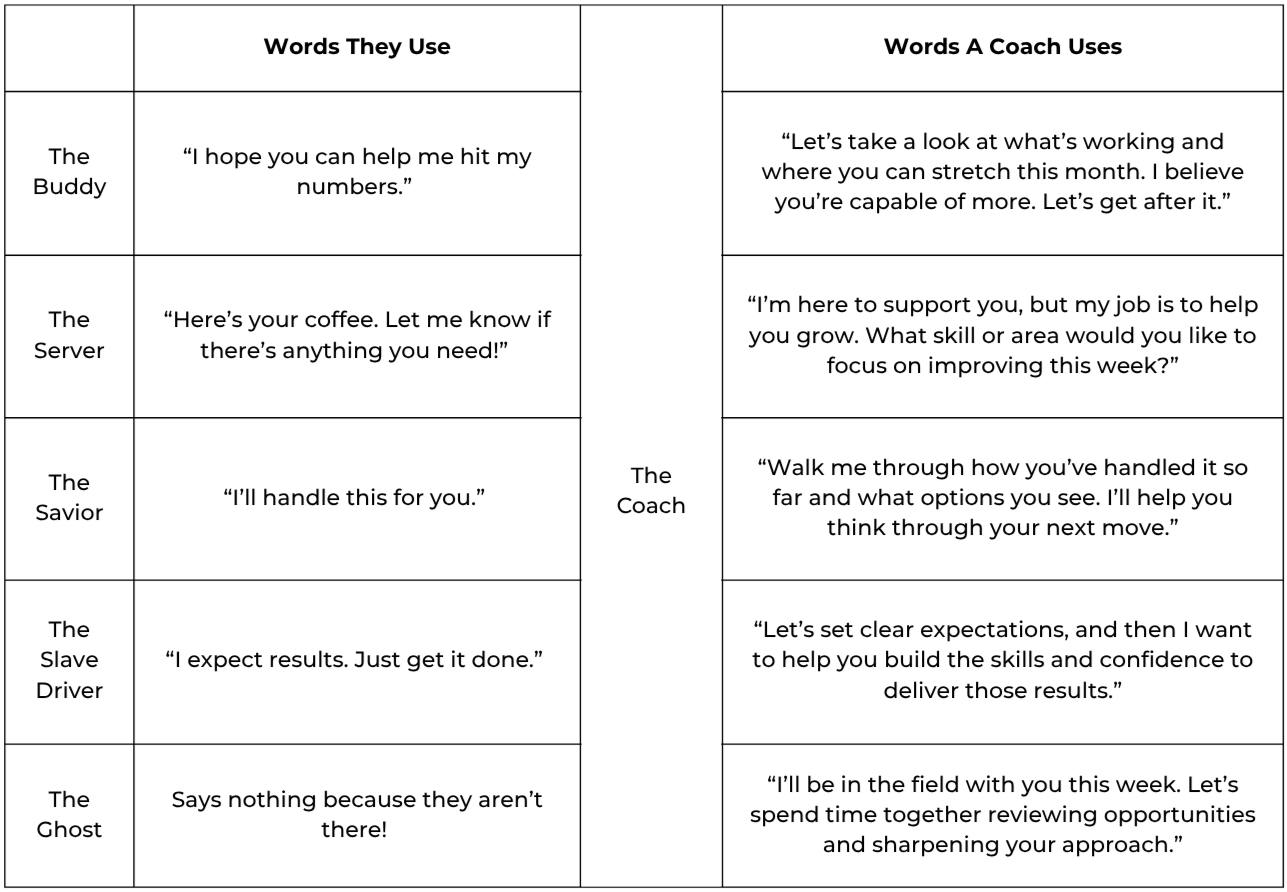
Second, pay close attention to the language you use with your team. The words and phrases you choose reveal far more about your leadership style than you might think. Compare what you typically say to the examples of Coach Language provided below. Do you sound more like the Buddy, the Server, the Savior, the Slave Driver, or the Ghost—or do your words reflect the mindset of a true Coach.
Summary
Most sales leaders step into their roles with little to no training on how to coach effectively. Left to figure it out on their own, many default into one (or more) of the five common manager styles covered in this chapter: the Buddy, the Server, the Savior, the Slave Driver, or the Ghost. While these styles often come from good intentions, they ultimately hinder the development of the team and the consistent growth of revenue.
Your goal, if you want to become a true RevenueGetter, is to consciously move toward the sixth style: the Coach. Coaching isn’t about pleasing, saving, or commanding your team. It’s about helping them think, act, and perform at a higher level. It’s about developing people in a way that drives results and builds their long-term capabilities. No manager stumbles into this style accidentally; it takes intention and practice. The next chapters will begin equipping you with exactly that.
Questions to Ponder
• Which of the five ineffective styles do you see in yourself today? Where is it showing up?
• When my team interacts with you, do they feel developed or merely managed?
• What is one tangible step you can take this month to start showing up more as a Coach and less as one of the default styles?
Chapter Three
Making the Identity Shift from Manager to Coach
Mastery is built in the margins—
when we focus on the smallest skills,
we unlock the biggest results.
—Unknown
Now that we’ve identified the kind of manager we don’t want to be, let’s shift gears and unpack what coaching actually is . . . and how to do it effectively.
In his book Talent Is Overrated, author Geoff Colvin makes a compelling argument: Top performers aren’t born; they’re built. Through his research, Colvin discovered that what separates superstars from everyone else isn’t raw talent but something called deliberate practice.
Although we’ll dig deeper into the concept of practice in chapter 12, it’s important to introduce Colvin’s five key elements of deliberate practice here. They give us a framework for understanding the true role of a coach and why focusing on microskills is so powerful.
According to Colvin, deliberate practice is
specific and goal driven,
mentally demanding,
not inherently enjoyable,
feedback rich, and
usually guided by a coach or expert.²
Let’s pause on that first point: specific. This is where most coaching breaks down. When we say specific, we mean micro. Not “get better at follow-up,” but “craft a stronger opening line in your voicemail.” Not “ask better questions,” but “replace yes/no questions with open-ended ones.” Specific coaching focuses on one targeted skill at a time; it zooms in, not out.
And this is where many sales leaders unintentionally go off course.
Rather than coaching one microskill at a time, they overtrain their team by throwing too much change at them all at once. I’ll never forget a meeting I sat in back in 2002. Four different departments were lined up to present to the sales team. #boring!
Each one got up and dumped a new “must-do” on the group. First, it was a new contract addendum. Then a change to how homes were added to the MLS (Multiple Listing Service). After that, an updated SOP. And so on.
Now let me ask you, do you think the sales team nailed the contract addendum the following week? How about the MLS update? The reality? Almost no one implemented any of it.
And when managers were asked why, the usual response was something like, “I don’t know. We told them what to do.”
That’s the problem with a macro-change approach: It overwhelms people. It’s too much, too fast, and without the structure of deliberate practice and focused coaching, it almost always falls flat.
Slow down in order to go fast.
² Geoff Colvin, Talent Is Overrated: What Really Separates World-Class Performers from Everybody Else (Portfolio, 2008).
The Power of One Thing
Think about a time when you had to learn a complex skill, maybe riding a bike, playing the guitar, or driving a car. How did you start? Did you just hop on the bike and pull off a wheelie? Pick up the guitar and nail the song “Little Wing” (the Stevie Ray Vaughan version)? Probably not.
Like most people, you started small. You learned in increments, piece by piece, building confidence and competence one step at a time.
I remember when I first learned how to play T-ball. It was the late ’70s, and my coach, Coach Jensen, had the mustache and the shorts to prove it. A fashion disaster? Absolutely. But a great coach? Without question.
Our first practice was at Studio City Park in Studio City, California. Coach Jensen gathered all of us around home plate. “This is home plate,” he said. Some of us nodded like we knew; others clearly had no clue.
Then he said, “You stand here and hit the baseball off the tee. Let me show you.” He grabbed a bat, teed up the ball, and took a swing.
Next, he placed another ball on the tee and asked, “Where are we?” We shouted, “Home plate!”
“And what do we do here?”
“Hit the ball!” we yelled.
He smiled and swung again.
Then he had us line up. One by one, each kid grabbed a bat, pointed to the ground, and said, “This is home plate!” then took a swing.
Here’s the key: We didn’t run the bases. We didn’t talk about scoring runs or fielding ground balls. On day one, all we did was learn where to stand and how to swing. That’s it.
That’s microskill development.
It’s focused, intentional, and narrow by design. Just like Coach Jensen, great sales coaches zero in on the fundamentals and isolate one small skill at a time. That’s how real learning (and real performance improvement) happens.
What Are Microskills?
So, what exactly are microskills? To define them accurately, we must look at the definition of both parts of the term. According to Dictionary.com, micro is very small in comparison with others of its kind.³ According to Britannica, the word skill is defined as the ability to do something that comes from training, experience, or practice.⁴ When you put the two definitions together, you get:
Microskill (noun): A very small, specific ability or behavior that comes from training, experience or practice; it is one component of a larger, more complex skill set.
As a point of comparison, look at this list of differences between micro and macroskills:
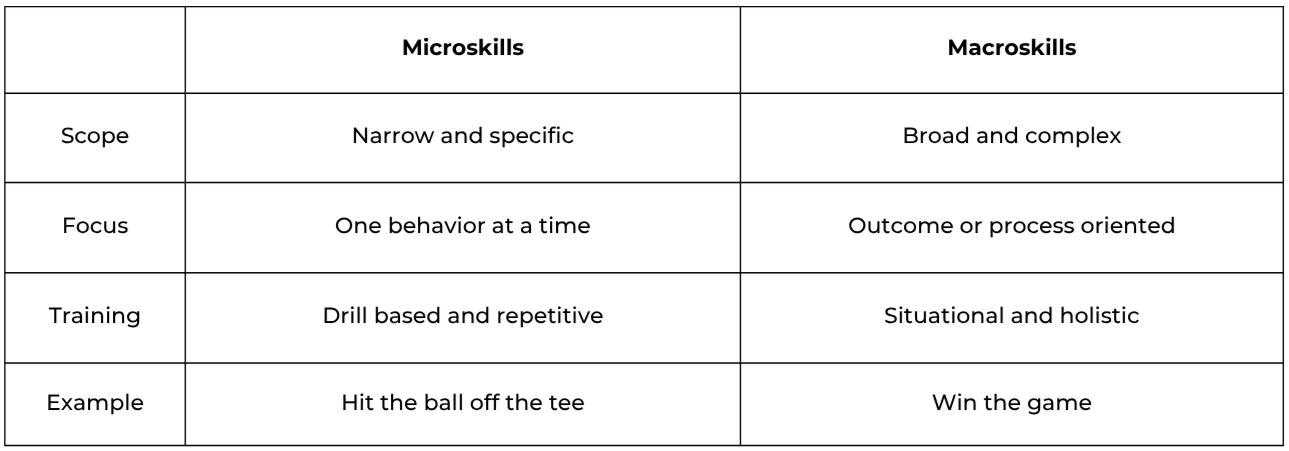
Look at the differences above and ask yourself, Which side do you tend to lean toward in your coaching, micro or macro? If you said micro, congratulations! You are a rare bird. My experience in watching sales leaders in the field is they almost always lean toward macroskills.
The question is: Why should you adopt microskill development at all?
³ Dictionary.com, “micro,” accessed September 3, 2025, https://www.dictionary.com/browse/micro.
⁴ Britannica Dictionary, “skill,” accessed September 3, 2025, https://www.britannica.com/dictionary/skill.
A Microlearning Success Story
American Tire Distributors (ATD), the world’s largest tire distributor, recognized the need to enhance their sales team’s training to maintain a competitive edge in the evolving automotive and tire service industry. While initial sales training was provided to new hires, ongoing development was inconsistently reinforced by managers.
In 2016, ATD appointed Rebecca Sinclair as chief people officer to revamp the company’s HR and learning strategies. Identifying the limitations of traditional training methods, Sinclair introduced Axonify, a microlearning platform delivering three- to five-minute daily lessons tailored to individual learning needs. This approach aimed to make learning convenient and habitual for employees.
The implementation began with a pilot program focusing on the company’s sales-force model.⁵ Within two to three weeks, participants exhibited significant knowledge improvement, which was sustained in subsequent evaluations. Encouraged by these results, ATD rolled out the platform companywide in mid-2017. The learning team collaborated with business leaders to develop relevant content, ensuring alignment with organizational priorities.
The microlearning initiative yielded impressive outcomes: Over 90 percent of the sales team engaged with the platform on eighteen out of twenty business days per month. Notably, the top 25 percent of sellers were among the most active users, while the bottom 25 percent engaged the least. For instance, targeted training on a specific manufacturer’s products led to a 5.5 percent sales increase, with an estimated 15 percent of that growth directly attributed to improved product knowledge.
Buoyed by this success, ATD expanded the microlearning program to operations and maintenance teams and introduced a paid version, Spark for Retail, offering customers access to the training. This initiative not only enhanced internal performance but also created a new revenue stream, demonstrating the broader business impact of effective microlearning strategies.
⁵ Sarah Fister Gale, “Case Study: American Tire Distributors Shares Its Microlearning Success Story,” Chief Learning Officer, 2025, https://www.chieflearningofficer.com/2019/12/12/american-tire-distributors-shares-its-microlearning-success-story/?utm.
The Three Types of Coaching Sessions
What is the biggest reason a macroskill focus dominates? Very simply, managers don’t have the time . . . or so they think. I will shoot you straight here. Microskill coaching takes more time. No questions about that. That being said, you have to work smarter, not harder, right? The question is: How do you do that?
I am glad you asked. Depending on the number of direct reports you manage, you might be able to do one-on-one coaching with every single person once a week. That would be my preference, but I know that isn’t always doable. Without adding an eighth day to the week, you have to get strategic with the time you do have.
With that being said, you will want to leverage the following three types of coaching sessions to make sure each team member is getting a form of microskill coaching.
Coaching Session #1: One-on-One
As I’ve mentioned, one-on-one coaching is the ultimate form of coaching. Just like people pay top dollar for personal trainers, acting coaches, or private batting lessons for their kids, the value comes from one thing: 100 percent focused attention on performance improvement.
This type of coaching allows you to zero in on specific skill gaps and tailor development to the individual salesperson. The impact goes beyond just improving results; it also builds trust, accountability, and a stronger relationship. After all, relationships grow when you invest time in helping someone become the best version of themselves.
Yes, one-on-one coaching takes more time, but the payoff is worth it. Just remember it’s not a “one-and-done” activity. Effective one-on-one coaching requires a strategic follow-up loop with intentional exercises, clear accountability, and a bit of healthy discomfort to drive growth.
We will dive into the specific steps of a one-on-one coaching session in chapters 8 through 11.
One-on-One Case Study
As of this writing, swimmer Michael Phelps is the most decorated Olympian of all time. Of course, he didn’t start out that way. When Phelps was eleven years old, all he had was some raw talent and tons of energy. He then met the man who would coach him to twenty-three gold medals, Bob Bowman.
Bowman saw greatness in Phelps and gave him more than some instruction on how to swim better. Bowman invested in Phelps for over twenty years. When I say “invested” in him, I mean he developed Phelps as an athlete and as a human. And his approach wasn’t always gentle.
“My job wasn’t to be his friend,” Bowman would later say. “It was to help him become everything he was capable of becoming.”
Here are just a few of the ways Bowman poured effort into Michael Phelps:
Professionally (Performance and Skill Development)
Identified potential early—recognized Phelps’s physical gifts and competitive mindset at age eleven.
Instilled elite-level discipline—designed grueling training schedules, including twice-a-day practices, 365 days a year (yes, even on holidays).
Built technical mastery—sharpened Phelps’s mechanics, starts, turns, and stroke efficiency with relentless detail.
Used mental rehearsal—taught Phelps visual techniques and goal-setting habits to prepare for every scenario.
Prepared him for adversity—simulated race-day setbacks (e.g., goggles filling with water) so Phelps could adapt under pressure.
Pushed him past limits—constantly raised the bar with personalized challenges and “stretch goals.”
Managed long-term performance cycles—structured training and rest around Olympic cycles to peak at the right moments.
Developed race strategy—helped Phelps become not just physically dominant but tactically smart in the water.
Personally (Mindset, Growth, and Life Coaching)
Taught emotional control—helped Phelps manage frustration, fear, and pressure (crucial for high-stakes competition).
Held him accountable—never let Phelps off the hook; challenged excuses and reinforced personal responsibility.
Provided structure and stability—became a steady presence during Phelps’s turbulent teenage years and early fame.
Guided him through struggles—supported Phelps during battles with anxiety, depression, and post-Olympic identity loss.
Modeled professionalism—showed what it meant to pursue excellence with consistency, preparation, and class.
Encouraged leadership—helped Phelps transition from solo competitor to team leader in later Summer Olympic Games.
Built lifelong trust—ensured that their bond grew beyond coach-athlete by becoming a mentor and a father figure to Phelps.
That level of intentional one-on-one coaching, focused on both performance and the person, is what transformed a talented swimmer into the greatest Olympian of all time.
Coaching Session #2: Small Group Coaching
If your team is on the larger side and you can’t meet with everyone one-on-one each week, small group coaching might just save the day.
This format allows you to develop key sales skills across a small peer group. Ideally, you want to involve four to six people per session. Sessions typically run an hour or two, but anything longer and you’re likely drifting away from microskill development and into training mode.
I often get asked, “When should I use small group coaching?” The answer is all the time.
I recommend getting a handful of your salespeople together at least a couple of times per month to work on revenue-generating skills as a team.
Here’s why small group coaching is so powerful:
Peer Learning: Team members get to hear how others think and apply techniques like overcoming objections, building rapport, and crafting follow-up strategies.
Increased Engagement: Let’s be honest: it’s easy to hide in big meetings. Not here. In a small group, everyone has to participate, which means you’ll hear from people you don’t normally hear from.
Safe Practice Space: Most people don’t love role-playing, but in a small group, it feels safer. There’s less pressure and more support. If you’re running the session virtually, break the group into pairs and use private breakout rooms for focused skill practice.
Coaching Session #3: Large Group Coaching
Large group coaching typically happens with your entire sales team, either in person or virtually. When I was a sales leader at a company in Phoenix, these sessions became the highlight of our weekly meetings. Instead of sitting through a boring presentation, the team got to engage, participate, and walk away with a real skill they could use immediately.
Ironically, large group coaching is the most common format . . . and also the hardest to run effectively. Why? Because it’s easy for people to hide, drift, or even fake participation, especially when you’re working on specific behaviors or microskills.
To make large group coaching sessions truly effective, here are four key principles:
1. Focus on One Microskill. I know it sounds obvious, but sales leaders often fall into the trap of trying to do too much. The thinking goes, “Well, I’ve got everyone here; might as well pack in as much as possible.” That’s a mistake. Too much content overwhelms your team and waters down the impact. Instead, go deep on one skill, like handling a specific objection or crafting a follow-up video.
2. Make It Interactive. The more your team engages, the more they’ll remember. Use these formats:
Group discussions
Quick pair-and-share moments
Small group role-plays
Games or challenges
Your goal isn’t to lecture; it’s to facilitate practice and peer learning.
3. Assign Coaching Roles. If you have a larger team, you’ll need help with hands-on coaching during the session.
Tap into other managers or team leads who are present.
Use peer coaching by breaking into groups of three:
- One person is the salesperson
- One is the customer
- One is the coach, giving feedback after the role-play
4. End with a Clear Call to Action. To ensure real-world application, always wrap the session with a specific task. If you just trained on video follow-up, challenge the team to send one personalized video to a prospect in the next twenty-four hours. Or make it fun: “Whoever sends the most follow-up videos this week wins a prize.”
That competitive nudge can drive real behavior change and give you great material to spotlight in your next session.
Summary
Mastery doesn’t come from doing everything at once . . . It comes from focusing on one small skill at a time. The best coaches know that real growth happens when you zoom in, not out. It’s not about getting better at follow-up; it’s about improving the first five seconds of a voicemail. Microskill development is where progress lives. The mistake many sales leaders make is trying to fix everything all at once, which overwhelms the team and leads to almost nothing sticking.
To avoid that trap, great leaders structure their coaching around focused, intentional formats: one-on-one sessions for deep development, small groups for peer learning and practice, and large group coaching for team alignment and momentum. Each session type plays a role, but the secret to effectiveness is the same across the board—narrow the focus, make it interactive, and always end with a clear next step. When a sales leader learns to coach this way, they stop managing from the sidelines and start actively driving performance. They become more than a manager . . . they become a RevenueGetter.
Questions to Ponder
• Do you tend to coach broad outcomes or specific behaviors? Think back to a recent situation… Could you have zoomed in on a microskill instead of giving general direction?
• Which coaching format are you using most and which are you underutilizing? How can you be more intentional with one-on-one, small group, and large group coaching to drive consistent development?
• Are you actively helping your team improve, or hoping they figure it out on their own? What would it look like for you to step fully into the role of a RevenueGetter this week?
what happens next
If this landed, it wasn’t motivation—it was a shift in what you’re responsible for.
What matters now is what you do with it.
Don’t leave this as something you just read.
Pre-order RevenueGetter today and unlock the 14-Day Quick Win Challenge immediately—so by the time launch day comes, you’re already ahead.
While others are reading, you’ll be executing.
15 minutes a day.
Measurable leadership shifts.
Early momentum.